There is a stretch of Chicago's South Side where the power grid can do something almost no American city grid can do: let go of itself, on purpose, and keep the lights on anyway. In April 2024, ComEd announced completion of the Bronzeville Community Microgrid, a neighborhood-scale system built with the support of U.S. Department of Energy grants. Wired beside it sits a second grid, older and quieter: the campus microgrid of the Illinois Institute of Technology, developed from 2008 and finished in 2013 on a campus whose master plan and most celebrated buildings were designed by Ludwig Mies van der Rohe. Linked together, the two form what ComEd and its partners describe as the first utility-operated microgrid cluster in the United States, and one of the first anywhere in the world.
I.A grid that can hold its own boundary
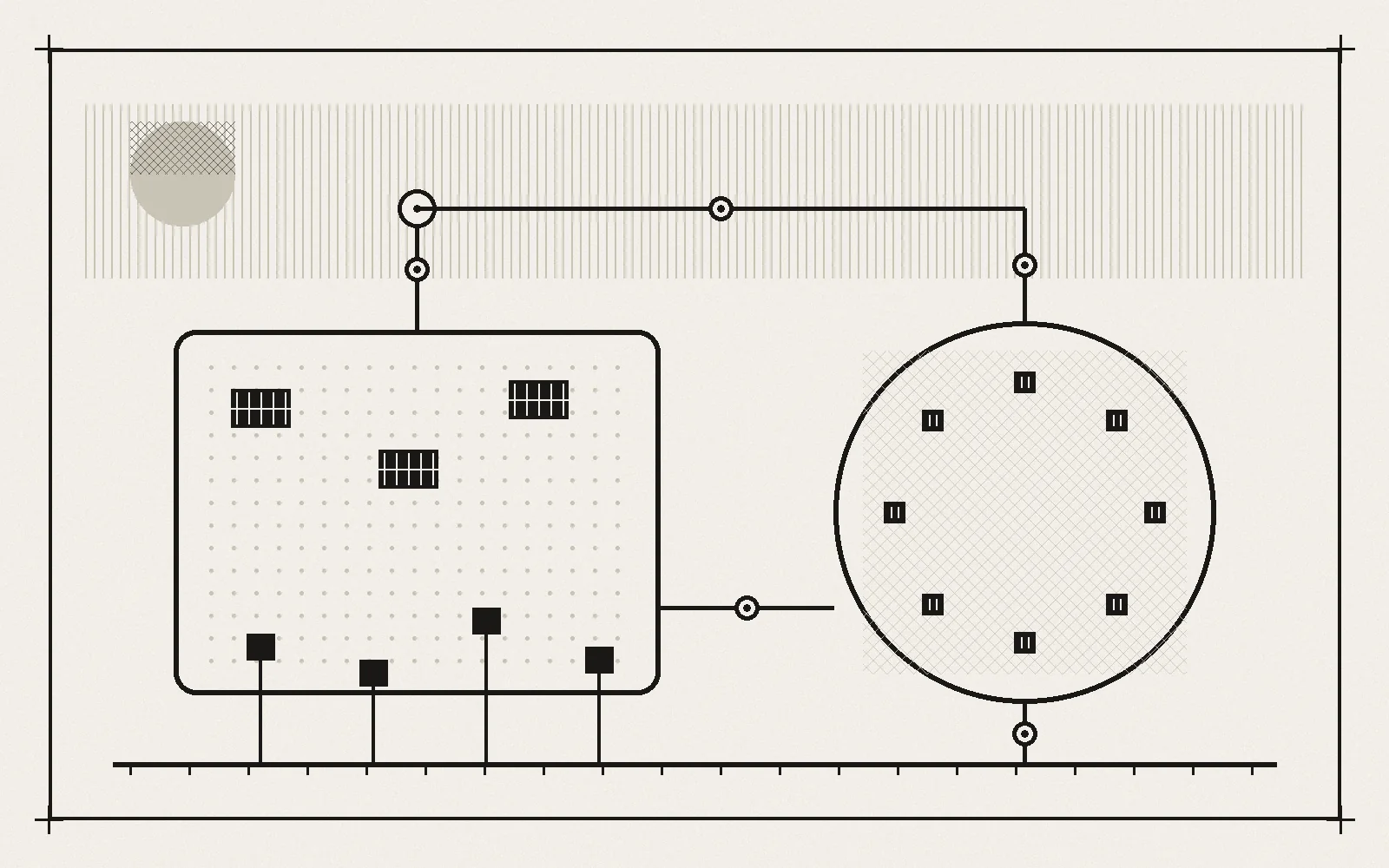
A microgrid is a local group of electricity sources and loads that can disconnect from the wider utility system and run on its own. In ordinary weather the Bronzeville system operates connected to the ComEd grid like any other circuit. When a storm or fault knocks out the surrounding system, automatic controls island it: switches open at the boundary, generation inside the footprint picks up the load, and the customers within the boundary keep power while the rest of the city waits in the dark.
That boundary is the engineering point. Islanding a neighborhood cleanly, without damaging equipment or destabilizing the wider grid when it reconnects, is the hard part of microgrid design, and it is what the cluster was built to prove at utility scale.
II.Bronzeville gets its own plant
The project grew out of ComEd's Community of the Future program, launched in Bronzeville in 2016 to test how distributed energy, storage, and smart controls could serve a dense urban neighborhood. Public reporting at the time put the planned system at roughly seven megawatts of load, and public descriptions after completion put the customer count at about a thousand homes, businesses, and public institutions.
Generation starts at the Chicago Housing Authority's Dearborn Homes, where rooftop and ground-mounted solar arrays supply what the housing authority has publicly described as roughly a tenth of annual electricity use across 17 buildings home to hundreds of families. Batteries and automatic switching do the rest, holding voltage steady when the boundary closes.
III.The campus that already knew how
Next door, Illinois Tech had spent five years, starting in 2008, rebuilding its own electrical system into what its Galvin Center for Electricity Innovation now runs as a roughly nine-megawatt campus microgrid: solar, storage, and smart controls that can carry the entire campus through an outage. University officials have said publicly the system saves on the order of a million dollars a year.
The pairing is almost too neat to be accidental: the one American campus Mies van der Rohe planned end to end, home of his Crown Hall, became the country's most watched classroom for how a city might power itself in fragments.
Two grids that can let go of each other, and hold.
IV.Two islands, one cluster
What makes Bronzeville different from every other American microgrid is the intertie. Siemens supplied the management software that lets the utility-scale neighborhood system and the customer campus system coordinate: sharing resources, balancing against each other, and islanding together when the wider grid fails. A single island is a machine. A cluster is an argument about how urban grids could be rebuilt block by block, and the Department of Energy funded the demonstration to settle it.
For a city whose energy history runs from the world's first central power station to the nuclear fleet that still carries most of Illinois' electricity, the cluster is a smaller, more local bet: that resilience will be built at the scale of a neighborhood, from the roof down.
V.Why a South Side neighborhood leads
Bronzeville is not a random test bed. Long described as the birthplace of Black History Month and the heart of Chicago's Black Renaissance, the neighborhood has spent a century turning infrastructure into institution-building. When Illinois' 2021 Climate and Equitable Jobs Act committed the state to 100 percent clean energy by 2050, with interim renewable benchmarks and workforce programs written into law, Bronzeville already had a working answer to the question the law poses: clean power that keeps a neighborhood's own lights on first.
ComEd, the housing authority, the university, and federal researchers will publish years of operating data from the cluster. This page will follow it. The rest of the city, flat-roofed and lake-cooled, is where the same bet gets tested next.